5 Ways Auto Recyclers Can Cut Chargebacks in Half
Chargebacks drain margin for auto recyclers. Learn five practical fixes to reduce disputes, win more cases, and speed up collections with a single workflow.
- Written by
- Sabhi Insights

Chargebacks do not start at the bank. They start in small gaps across the sale. A quote that lives in one tool. A payment link in another. A shipping label that never gets attached to the order. A return handled over the phone with no record. Each gap adds doubt. Doubt turns into disputes. Disputes turn into lost margin and wasted hours.
The good news is that most chargebacks are preventable with better handoffs and a clean audit trail. In this guide, we outline five practical moves any yard can make to cut disputes in half.
These steps do not require a new headcount or a complete system swap. They require a standard way of working from quote to payment to shipping to RMA, and a place to keep the facts together.
We will also show where Sabhi fits into the workflow and how operators use it to bring down disputes and speed up collections without changing their YMS.
The Problem: Fragmented Tools Create Doubt and Delay
Most growing recyclers use a stack of point solutions. Messages and calls happen in one inbox. Invoices and links live in a payment app. Labels are booked somewhere else.
Returns are handled by text or a handwritten note. The team can make a sale, but when an order goes sideways, no one can show the full story in a clean timeline.
What chargebacks actually cost a yard
- Lost product value when parts are not returned or are damaged
- Processor fees and penalties on each dispute
- Two to four staff hours to rebuild timelines and respond
- Return shipping and re-stocking overhead
- Slower cash flow that drags collections and payouts
There are also process gaps. First time buyers do not get a quick verification. High value orders do not get a second check on address or delivery instructions. RMAs are inconsistent across reps, so the photos and condition notes are hit or miss. Each gap is small on its own. Together they create enough room for disputes to grow.
Two outcomes follow. Margin erodes as write-offs accumulate. Time is lost back-and-forth with buyers and processors. Both are expensive. The fix is not more software. The fix is a clear sequence with proof embedded at each step.
Standardize the Hand-Offs
You win chargebacks the same way you prevent them. You create a consistent flow, keep the customer in the same thread, and tie every action to a time stamp and a person. Here are the first three steps to standardize handoffs and remove doubt.
1) Take payment in the same thread as the quote
Keep the quote, the invoice, and the payment receipt together. When a buyer disputes the amount or claims the item changed, you can show a single thread that includes the quote they accepted, the invoice they paid, and the receipt that confirms it.
How to implement today
- Send a payable invoice link inside the conversation where you shared the quote.
- Capture the buyer name, last four digits, and a unique invoice number.
- Store the receipt in the same thread and tie it to the order.
What this prevents
- “Price changed” claims.
- “I never saw that invoice” claims.
- Confusion across staff when orders are handed off.
2) Share tracking and proof of delivery automatically
Buyers file claims when they cannot see the status. Remove the mystery. Attach the label to the order record. Post tracking events back to the thread. At delivery, save the carrier’s proof or a photo. When a buyer says the shipment never arrived, the trail answers for you.
How to implement today
- Book labels through a system that returns the label file and tracking number to your order record.
- Auto-post key tracking events to the thread.
- On delivery, store the proof of delivery or a photo link beside the invoice.
What this prevents
- “Items never received” claims.
- “No tracking provided" claims.
- Hours spent hunting status across portals.
3) Standardize RMAs with photos and reason codes
Returns are part of the business. Chargebacks do not need to be. A single RMA form with required photos, reason codes, and condition notes will close most “not as described” and “damaged” claims. The intake photo when the item arrives at the yard seals the loop.
How to implement today
- Use one RMA form for every return.
- Require at least two photos before approval.
- Ask for a concise reason code.
- On arrival, take a quick intake photo and attach it to the same thread.
What this prevents
- Vague “not as described” claims.
- He said, she said disputes on condition.
- Inconsistent treatment across reps.
Build Risk Checks and an Audit Trail
Once you have consistent handoffs, layer in simple risk checks and make the audit trail easy to export. These last two steps reduce exposure from high risk orders and speed up your win rate in the cases that do happen.
4) Verify buyers on high-risk orders
Not every order needs extra steps. Some do. First time buyers, mismatched address data, repeat refund requests, and high value transactions deserve a quick verification. A one minute call or a second factor confirmation is often enough. Log that the check happened beside the invoice.
How to implement today
- Define a basic threshold for “high risk” in your team playbook. For example, first order over a set amount or address mismatch.
- Add a one minute verification step for those orders.
- Record the call or note the confirmation and store it with the invoice.
What this prevents
- Fraudulent card use and friendly fraud.
- Processor pushback when you cannot show buyer confirmation.
- Staff guessing when to escalate.
5) Keep an audit trail for every step and make it exportable
When a dispute lands, the fastest path to a win is a packet that tells the story without commentary. Quote sent. Buyer accepted. Invoice paid. Label booked. Tracking delivered. RMA issued. Time stamps and names. One export. No screenshots.
How to implement today
- Use a system that turns the order timeline into a single export.
- Make the export a standard step whenever a dispute opens.
- Keep a short template for the processor with the key facts in order.
What this prevents
- Delays that cause automatic losses.
- Conflicting narratives from different team members.
- Rework every time a case appears.
Where Sabhi Fits In
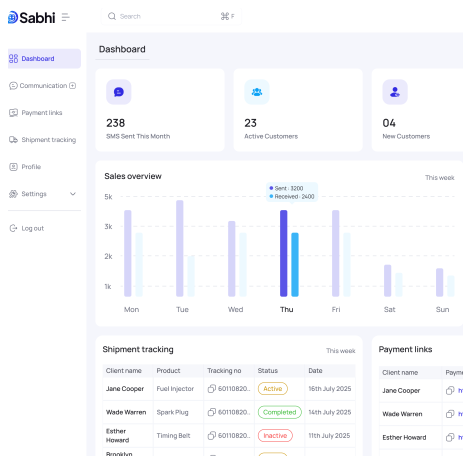
Sabhi was built for the standard flow described above. Operators manage quote, pay, ship, and RMA on one screen with a unified inbox and a built-in audit trail.
The same thread that holds the buyer’s first question also holds the quote, the payable invoice, the label, the tracking updates, and the RMA if needed. Your team does not jump between apps to collect evidence. The evidence is already in the order timeline.
Recyclers using this approach report fewer disputes and faster collections while keeping their current YMS. Sabhi is integrated where it matters and is compatible with leading yard systems, so you do not need to rip and replace.
You keep your yard software. You standardize the handoffs around it. The result is a cleaner buyer experience, fewer holes for disputes to hide in, and a response packet your staff can produce in minutes.
Two other points matter to owners and controllers. First, compliance. Messages stay A2P safe. Payments remain PCI compliant. Card data is handled in the right place and never leaks into chat or email. Second, accountability.
Every action is time stamped with a user name. If a dispute appears, you can see exactly what happened and when. That clarity turns into better training and fewer repeat mistakes.
Putting It All Together
A standard workflow is not about adding friction. It is about removing ambiguity. Buyers get a consistent flow. Your team gets one place to work. Disputes either do not happen or can be answered with a clean packet. That is how yards protect margin as volume grows.
Here is the sequence to roll out over the next two weeks.
Week 1: Payment and tracking inside the thread
- Move all invoices and payment links into the same conversation that carries the quote.
- Set up automatic tracking posts that attach to the order thread.
- Train the team to store receipts and delivery proofs beside the invoice.
Week 2: RMA standard and risk checks
- Publish a single RMA form with required photos and reason codes.
- Define a simple rule for high risk orders and add a one minute verification step.
- Create a dispute export template with the exact order of proof your processor expects.
- Test the export on a closed order so the team knows the steps.
What To Do Next
- See the workflow: quote to payment to shipping to RMA on one screen → Product overview
- Read the case study: how a multi yard recycler reduced disputes by about 40 percent and sped up collections → Case study
Recyclers do not have to accept chargebacks as a cost of doing business. With a clear flow and a tight audit trail, you can cut disputes in half, win more of the cases that do arrive, and keep cash moving without adding more steps.